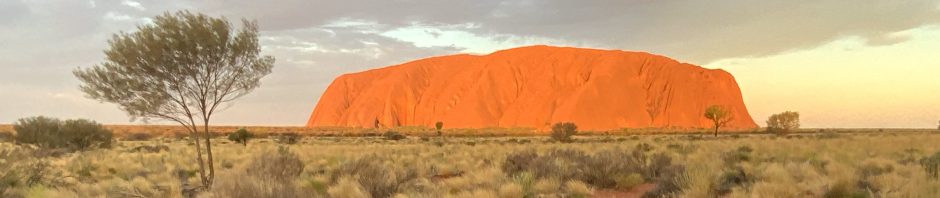
We do some bird surveys in the late afternoon, the Blue Bush Plains are quite pretty at this time.
Despite the weather generally warming up we are not advocates for swimming on our beach, being accustomed to warm sub-tropical waters, bathing in the cold waters of the great Southern Ocean under heavy unbroken cloud cover hasn’t been a priority. The cold water is directly related to the ocean currents that exist in this part of the world. These currents and prevailing wind explain the algal blooms we have seen recently as the upwelling of nutrient rich water results from the combination of currents and wind. Then there are the clouds (weather).
As we produce weather data for the Bureau of Meteorology we have a new appreciation of clouds, in particular cloud types. We will never look at clouds the same again as we did before moving here. We have had lots of clouds, so many and varied one could say its cloud heaven. However, there is one type of cloud that fascinates us and its the stratocumulus that streams off the Southern Ocean and blankets us in . cloud, yet you can travel 10 km to the escarpment and it is all but gone. Strato- and cumulo- are latin for layer and heap, respectively. NOAA describe marine stratocumulus (MSCs) as clouds that typically lie at low-altitudes below 6,000 feet, covering about 20 percent of the low-latitude oceans, or 6.5 percent of the Earth’s surface, usually forming over water and have either closed- or open-cell forms—the difference has to do with their cloud cover. Closed-cell MSCs cover nearly 100 percent of the underlying Earth’s surface and reflect a large portion of solar radiation. Open-cell MSCs, on the other hand, have broken cloud structures that surround areas of clear sky, which do not block much solar radiation.
Our favourite bird survey trip is to Twilight Cove via Kanidal Beach it is remote, wild and beautiful. A cool day with cloud but it made for good photos and adventure.
We take our guest to the Burnabbie ruins and drive further east to the Burnabbie rock hole, and this time we find the ruins of the Linesman Camp. We also notice the man made drip line cemented onto the rock-face to direct water into the Burnabbie rock hole, a natural feature.
We also continue to see our Scarlet-chested parrots, Brightly colored nomadic desert parrot with a relatively short tail, mostly found in the Great Victoria Desert, with very occasional records outside this area. Feeds on the ground in arid bushland. Male has intense blue head, rich scarlet chest, green back, blue wings, and yellow belly. Female lacks scarlet chest and has much more subdued coloration, with pale bluish face and wings; similar juvenile has pale bill. In flight, upperparts show dark blue outer wing contrasting with pale blue inner wing and green back.
And our resident Death Adders visit us from time to time.


